
The suspension comparison
Hardtail vs Full-Suspension Electric Mountain Bike
By Sébastien L. (author profile in French)
Published
Experience alone does not settle the choice. A beginner riding rocky terrain and an experienced rider on smooth tracks may sensibly choose different bikes.
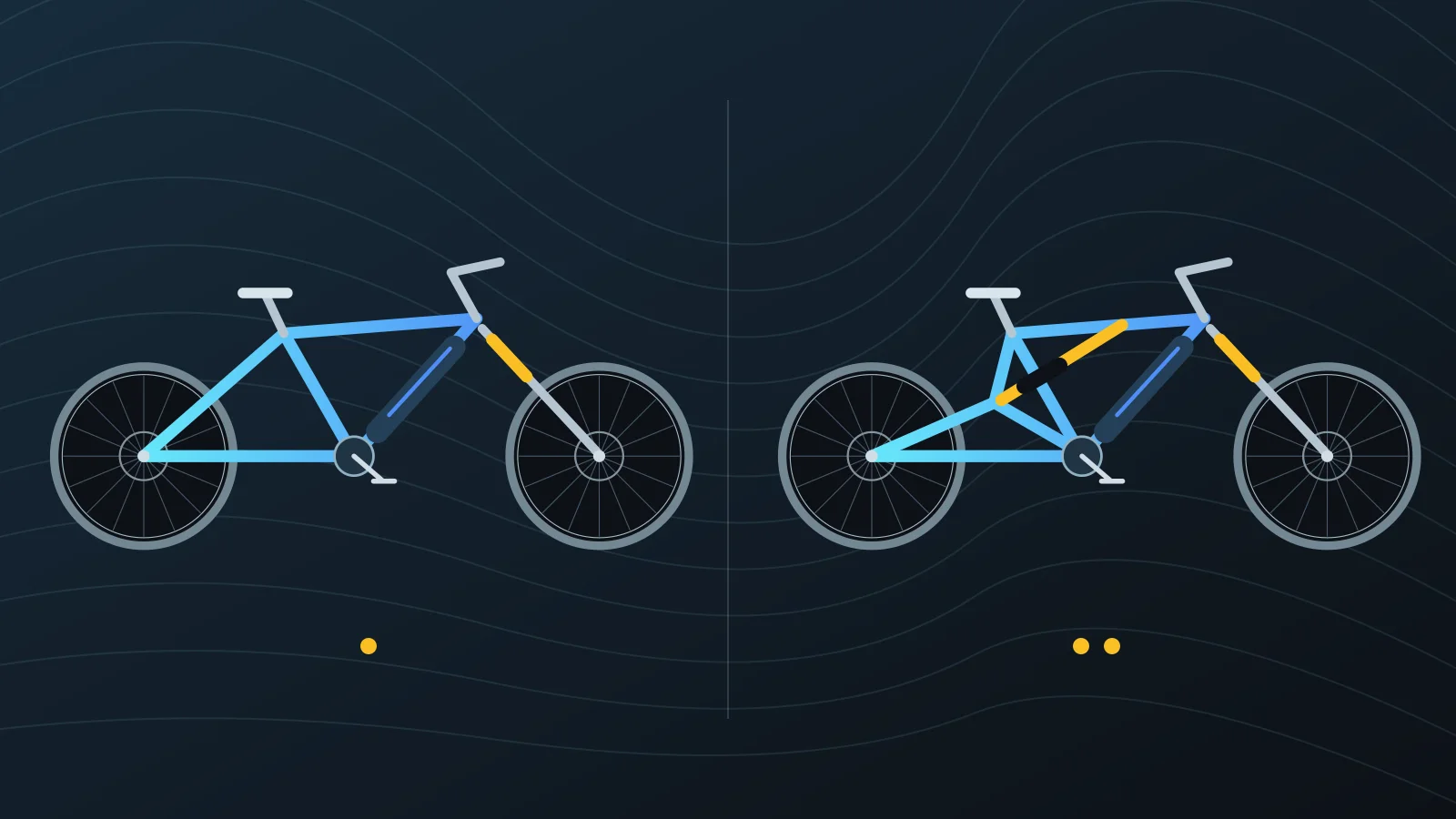
The difference is at the rear wheel
A hardtail has a suspension fork and a rigid rear end. A full-suspension bike adds a rear shock and an articulated system that lets the rear wheel move. Wheel travel is not the same measurement as the shock’s stroke.
Assistance reduces some of the pedalling effort. It does not remove impacts or replace technique. Suspension still needs suitable tyres, properly set-up brakes and a speed you can control.
Compare the practical trade-offs
| Factor | Hardtail | Full suspension |
|---|---|---|
| Price | Budget spread across fewer components | Articulated frame and shock add cost |
| Weight | Often lighter at a similar level | Additional rear suspension hardware |
| Comfort | Your legs absorb more rear-wheel impacts | Rear suspension filters some impacts |
| Maintenance | Fork service and normal bike maintenance | Add shock, frame pivots and bearings |
| Smooth-ground efficiency | No rear suspension movement | Depends on the frame and setup |
| Range | No universal percentage advantage | No fixed penalty: tyres, terrain and modes also matter |
| Smooth tracks and forest roads | Sensible if comfort is sufficient | Choose for specific terrain or comfort needs |
| Trails, rocks and roots | Requires more absorption with your body | Can help maintain rear-wheel contact |
| Rough descents | More demanding physically and technically | Preferable if designed for that use |
| Leisure riders and beginners | Approachable on appropriate terrain | Can build confidence on uneven terrain after setup |
| Experienced riders | A deliberate choice for simplicity | A choice for terrain demanding more suspension |
On a small screen, scroll the table horizontally to see all columns.
Three riding situations to help you decide
The relaxed weekend track ride
If your usual route avoids repeated roots and steps, start by trying a hardtail. Check comfort at your hands, saddle and back before paying for more suspension.
The rough woodland loop
If constant impact absorption leaves your legs tired, try full suspension on comparable terrain. The comfort and control you feel matter more than a small difference in advertised travel.
Mountains and long descents
Consider the chassis, brakes and tyres alongside the rear shock. A recreational full-suspension bike is not automatically an enduro or bike-park bike.
Will a hardtail always go further?
No. We do not assign a range percentage to either design: that would require controlled comparisons of bikes and routes. Different tyres or a higher assist setting can change the outcome more than suspension type alone.
For a purchase, compare usable capacity, complete weight and the stated conditions. A ride measurement also needs suspension settings, climbing, weather and total load. A calculator still provides only an estimate.
Plan for setup and ownership costs
Ask for the service intervals for the exact components, the price of a fork service and, on a full-suspension bike, shock and pivot servicing. Do not assume one brand’s maintenance schedule applies to every system.
Have sag, the suspension settling under rider weight, and rebound, its return speed, set according to the manuals. A lockout setting is intended for the situations specified by the manufacturer. It does not permanently turn the bike into a hardtail.
Explore the bike section
The e-MTB guide
Electric Mountain Bikes: Start with Your Terrain
Mid-drive motors, torque, watt-hours, range, suspension and budgets: practical answers to help you choose an electric mountain bike.
Read the guide →Le Tech bike ride reviews
Electric Bike Reviews
Follow future Le Tech electric bike ride reviews: testing conditions, measured range, clear disclosures and buying guides available now.
Read the guide →Editorial selection · 2026 edition
Best Electric Mountain Bikes 2026: Which One Should You Buy?
Three sourced e-MTB candidates for beginners, recreational riding and premium trail budgets. Dated European prices, equipment and clear evidence limits.
Read the guide →The e-MTB buying guide
How to Choose an Electric Mountain Bike in 2026
Budget, fit, geometry, motor, battery, brakes, wheels and support: a practical e-MTB buying guide with France and EU regulatory context.
Read the guide →Sources and editorial transparency
Sources consulted on . Our recommendations are editorial judgements. Manufacturer documents support specifications, not a Le Tech ride verdict. An editorial update does not renew a price or stock observation.